CAROLINE CARLSMITH CONSERVATION
Create Your First Project
Start adding your projects to your portfolio. Click on "Manage Projects" to get started


#CombatCovid (2020), Various Designers
Project type
Conservation Documentation and Digital Preservation Research
Location
Cooper Hewitt, Smithsonian Design Museum, New York
Date
2022
Role
Conservator: Caroline Carlsmith
Supervising Conservator: Jessica Walthew
Material
Proprietary Adobe digital project files
Link
SUMMARY
In 2022 I undertook the conservation documentation of complex Adobe files acquired by the Cooper Hewitt, Smithsonian Design Museum within their acquisition of the #CombatCovid digital poster series.
This work was the subject of my presentation at the 2023 ANAGPIC conference at Harvard University, as well as a forthcoming article in the Contemporary Art Network Review (Volume 3, 2024) "Ethical and Technical Challenges in the Conservation of Digital Process Files".
#COMBATCOVID
In 2022, alongside conservator Jessica Walthew and curator Andrea Lipp, I studied and helped preserve a group of digital posters recently acquired by Cooper Hewitt, Smithsonian Design Museum from Poster House. These digital images and animations were inspired by printed poster campaigns from the polio epidemic and were displayed around New York City on digital billboards and Link kiosks as part of the 2020 #Combatcovid public service campaign. My research focused on preserving five of the twelve digital posters which were received by Cooper Hewitt as layered Adobe documents.
New York City saw enormous loss of life to Covid-19 in the first few months of the pandemic. The #Combatcovid digital posters were commissioned, completed, and exhibited quickly to publish their urgent messages promoting social distancing, mask wearing, hand washing, and gratitude to essential workers as expediently as possible. The rapidity and diversity of the responses to the design brief meant that the posters were delivered in a variety of digital formats ranging from single export files to multiple file formats, resolutions, aspect ratios, or even designs. Most of the designers produced their posters within an Adobe software environment, and some of them delivered their contributions alongside the Adobe process files they had created. Whether native to Photoshop, Illustrator, or After Effects, these process files held layers of information which could not be seen in the export files. While none of the process files were very complex, even subtle differences in the ways each designer manipulated layers spoke to an individuality of approach, just as much as the aesthetic differences between the final images did.
At many museums, these process files might have been archived and ignored, with what digital preservation efforts were available focused on the export files. But Cooper Hewitt is an unusual museum in that it collects and seeks to preserve not only finished products, but also processual material for future scholarship. As design grows increasingly digital, the institution has begun collecting digital-born time-based media artworks, and with them, related digital process materials. Because of the museum’s unique focus and status as a federal institution, Cooper Hewitt is also well positioned to ask questions about how best to preserve this type of digital material, which may in turn help other organizations including fine art collections as well as graphic design firms plan for their own preservation of Adobe files.
TREATMENT
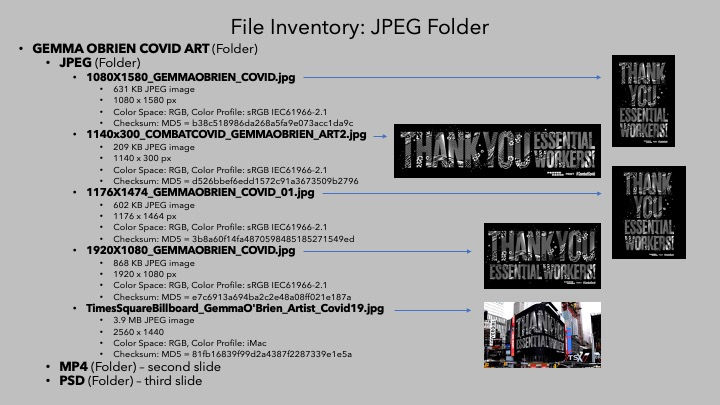
Because Adobe software is changing so quickly and emulation of the Creative Cloud is not available, preserving the Adobe process files related to #Combatcovid required documentation as a primary strategy. Our documentation included generating checksums, recording metadata, visually describing the file layers, and creating screen recordings on the process files being manipulated in their native software. We also conducted video interviews with two of the designers about their own use-pathways in the process files, and these recordings are retained in Cooper Hewitt’s Digital Asset Management System (or DAMS). During our research into Adobe process files more generally, we interviewed archivists from Special Collections and Graphic Design backgrounds, as well as Adobe programmers, including an Adobe employee who helped invent the PDF, to collaboratively think through how these processual works might be best preserved for the far future.